
There are some places that become far more important than the building they occupy and Kensington Market was one of them.
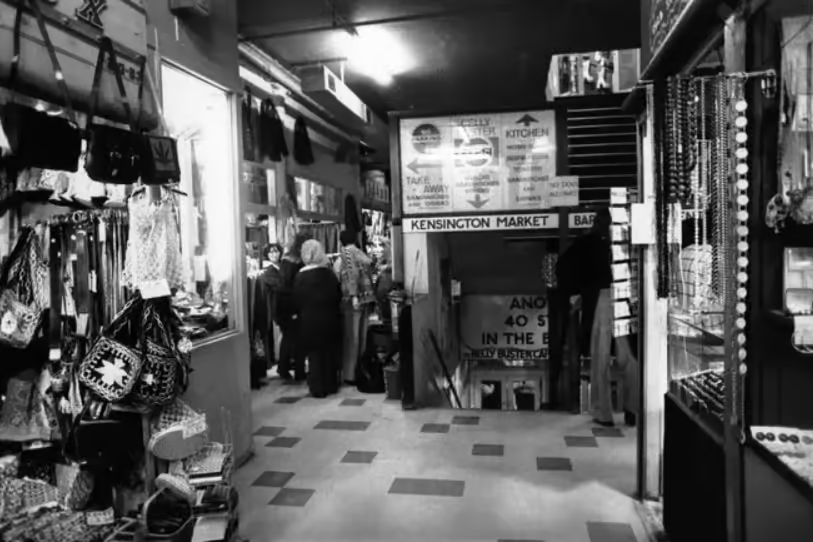
For 33 years, from 1967 until 2000, this slightly chaotic indoor market on Kensington High Street became a home for people who didn't necessarily fit into London's conventional fashion world. Designers, musicians, vintage sellers, punks, hippies, New Romantics, goths, club kids and wonderfully eccentric Londoners all passed through its doors.
Today, when we're used to young designers launching themselves through Instagram and selling directly to customers online, it's easy to forget how important physical places once were to fashion. If you were young and creative but didn't have the money, connections or experience to open a conventional shop, a market stall could be your beginning, and Kensington Market became one of London's great fashion laboratories.
1967: Kensington Market opens
Kensington Market opened at 49–53 Kensington High Street on 15 September 1967, right in the middle of one of the most extraordinary periods in British fashion.
London in the 1960s had become a centre of youth culture, the miniskirt had arrived, boutiques were replacing traditional fashion establishments as places where young people wanted to shop, and areas such as Chelsea and Kensington were full of experimentation.
By the latter part of the decade, however, fashion was changing again. The polished, graphic look we associate with the earlier Swinging Sixties was giving way to something looser and more bohemian. Young people were mixing second-hand clothes with pieces inspired by India and other cultures, wearing longer hair, embroidered fabrics, flares and increasingly theatrical clothes.
The V&A describes Kensington Market as becoming a “mecca” for young people wanting to create their own alternative look. Colourful clothing, much of it sourced from India, sat alongside second-hand pieces and clothes that didn't look remotely like the conventional fashions being sold elsewhere.
This is where markets become particularly interesting, a department store has to have some idea of what will sell, but a tiny independent trader can take a chance. And when you put dozens of those people together under one roof, fashion can start moving very quickly.
1969: Freddie Mercury behind a market stall
One of the stories that has become inseparable from Kensington Market is, of course, Freddie Mercury. Before Queen existed, Roger Taylor began running a stall at Kensington Market in 1969 and Freddie joined him. They sold clothes to London's increasingly adventurous young shoppers. There's something wonderful about imagining Freddie behind a market stall before the world knew who Freddie Mercury was!
But it also tells an important story about Kensington Market, these weren't simply retailers selling fashion to musicians. The musicians, designers, artists and sellers were often the same people.
The boundaries between music, fashion and nightlife were incredibly blurred. Someone selling you a jacket might be playing in a band that evening while someone shopping beside you might become one of the most recognisable musicians in the world.
Zandra Rhodes also had a presence at Kensington Market in its early years, long before becoming the internationally recognised British designer we know today.
The 1970s: from flower power to punk
The 1970s are where the story becomes even more interesting because London's fashion tribes began multiplying. The hippie influence didn't disappear when the calendar reached 1970, bohemian clothes, vintage pieces, craft, ethnic textiles and second-hand fashion continued to thrive.
By the middle of the decade, punk was emerging only a couple of miles away around the King's Road, where Vivienne Westwood and Malcolm McLaren's shop went through its famous incarnations and helped create the visual language of British punk. And Kensington Market was exactly the kind of environment in which this new fashion could flourish. Punk wasn't really designed to be neat. It was DIY, customised and confrontational - clothes were ripped, pinned, painted, altered and mixed with fetishwear, military surplus and second-hand pieces.
The 1980s: London's tribes take over
By the 1980s, Kensington Market had become a destination for an extraordinary mixture of subcultures! Punks were joined by New Romantics, goths, rockers and metalheads. Fashion existed alongside record stalls, jewellery, accessories, hairdressers and body art.
You didn't necessarily go there because you needed a new jumper, you went because those were your people - your tribe.! I'm sure that is one of the reasons places like Kensington Market mattered so much to the youth and fashion tribes of the 60s,70s & 80s. Before social media, finding your tribe required geography. If you lived in a town where nobody dressed like you, listened to the music you liked or understood why you'd chosen to look the way you did, London offered places where suddenly you weren't strange at all.
David Bowie shopped there. Boy George shopped there. Musicians, stylists, designers and young Londoners wandered through the same labyrinth of stalls, fashion ideas weren't being handed down neatly from designers to consumers, they were travelling sideways.
The late 1980s and 1990s: the next generation
As fashion changed, Kensington Market changed with it, that may be the most remarkable part of its history, that it didn't remain preserved as a 1960s hippie market. It continually absorbed whatever London's youth culture became next. By the late 1980s and into the 1990s, club culture, rave, goth and increasingly experimental fashion became part of the mix. And one particularly important name emerged from this period: Hyper Hyper.
Hyper Hyper created small spaces for young designers and creatives, providing an accessible way to sell directly to the public. Designers associated with it included Pam Hogg, Rachel Auburn, Fiona Cartledge of Sign of the Times and the extraordinary Leigh Bowery. Eventually Hyper Hyper became successful enough to move into its own premises across Kensington High Street in 1996., taking up residence in the old Antiques Hypermarket over the road.
Again, there is something in that story that feels incredibly relevant today, that you didn't necessarily need a huge investment, just a rail, a small space, some clothes and somewhere that attracted the right people.
Markets could provide the first rung of the ladder.
29 January 2000: the end of Kensington Market
- Kensington Market finally closed on 29 January 2000.
- The building was subsequently left empty and demolished in 2001, and London lost something that is actually quite difficult to recreate because you can't manufacture 33 years of accumulated culture.
What Kensington Market gave London fashion
I think Kensington Market's real contribution to fashion was much bigger than any individual designer or famous person who passed through it - It provided permission to experiment. London fashion has always had an extraordinary ability to produce outsiders. Vivienne Westwood, Alexander McQueen, Pam Hogg and countless others built careers around ideas that weren't polite, commercial or immediately understandable and that creativity doesn't happen in isolation.
It needs ecosystems, clubs and colleges and pubs and cheap studios and little shops and markets where somebody can try something without first presenting a business plan to a boardroom.
Kensington Market was part of that ecosystem.